
How Can I Find My Unique Writing Voice? Part 1
You’ve read the craft books, maybe even submitted a manuscript, and someone, somewhere has indicated the need for a “strong, authorial voice.” Editors’ websites (mine included) promise “voice preservation” as if this nebulous “voice” concept is as near extinction as a white rhino. Hell, with the way AI is stampeding across the publishing world, it might just be, but that’s another topic for another post.
To the current topic, what exactly is voice and how can you find the one that’s uniquely yours?
Is writing style the same as writing voice?
A writer’s style and a writer’s voice are not the same, but they are inextricably linked. Think: body and spirit, notes and music, grammar and meaning. Like the body, the notes, and the grammar, writing style can be trained. It’s a conscious, learnable skill. Voice, on the other hand, is like the spirit, the music, the meaning. It’s something innate within each one of us. It’s unique, it’s untrainable, it just is.
Does everyone have a writing voice?
Now, before the concept of unique untrainability sends you skittering into a dark corner to hug yourself and rock, convinced you don’t possess this unique, untrainable is-ness and will therefore forever fail as a writer — stop.
You may not be a top athlete, or able to make music, or even much meaning…yet.
But if you’re reading this, you exist. If you exist, I believe (and many will agree) that you have a spirit. If you call it something else, that’s fine, but whatever you call it, I expect we can agree that each one of us possesses something beyond the bag of bones we were born into.
Call it personality. Call it the subconscious. Call it instinct, psyche, sensibility, essence, je ne sais quoi. You get the idea.
Call it whatever connects with you.
My point is this: we all have it. I do. You do. That annoying neighbour who votes the wrong way and sings opera off-key at 3 a.m. does (although he clearly shouldn’t…).
Let’s think about that annoying neighbour for a minute. He’s not good, but he is authentic. He’s doing his thing, his way, and he’s probably pretty happy about it. He’s found his voice, damn him.
Meanwhile, you’re quite likely miserable because it’s 3 a.m. and you were asleep but now you’re not and your crappy neighbour’s crappy authenticity has disrupted your dreams and all you can do is lie there tangled in blankets and dwell on your writerly inadequacy because you can’t find your damn voice and it’s not freakin’ fair.
He’s found his voice, damn him.
It’s not fair, no, but just like your voice, it is.
So watcha gonna do about it?
I’ll tell you.
First, you’re going to figure out why your voice insists on being such an elusive little minx. Then you’re going to coax it, or possibly beat it, out of the shadows. Whatever it takes.
I reckon there are several reasons why your voice may be playing coy.
- Fear (good old-fashioned performance anxiety, self-consciousness, perfectionism)
- Deference (over adherence to craft rules, comparison to others, imitation)
- Disconnection from self (who am I—really?)
Why does fear block my writing voice?
What will they think? What if this is bad? What if my opinions are wrong? What if I say the wrong thing in the wrong way? What if I’m (gasp) different? How can I put it out there if it’s not perfect? What if I upset my friends, my family, my crappy neighbour of the off-key operatics, or all the faceless, nameless people on the internet? What if I upset the status quo? OMG, what if this is too me?
Need I say more?
In this case, you probably know what you want to say and even how you want to say it, but you hold back to protect yourself. If you’re not seen, then you can’t be wrong.
Why do I compare myself to other writers instead of finding my own voice?
This is deference, and that’s how you learn. And learning is good and right and necessary. But sometimes, you get stuck. You read the writing guides, absorb “show, don’t tell,” “kill your darlings,” “never start with a dream or the weather,” “avoid adverbs,” “short sentences in action scenes, long sentences in reflective ones,” “active sentence = good, passive sentence = bad,” etc., etc., etc.
Suddenly you can’t move. It’s all too much and every sentence you write, if you manage to write one at all, is wrong. You examine your manuscript; you know, the one you wrote with such joyous abandon before you learned how to write, and it’s awful.
Now you’ll never write like Stephen King or Anne Rice or Sally Rooney or Andy Weir or Joan Didion or <insert name of favorite writer>.
Well hallelujah! Go to the top of the class.
Of course you won’t write like them. You don’t need to. You shouldn’t.
You need to write like you.
And as for all that craft advice… Well, craft is important (more on that later), but understand for now that most of these pithy soul-destroying snippets are touted about the internet as absolutes, completely out of context. Any one of them is enough to wreck a good piece of writing. Together they’re enough to destroy all your fun and deprive the world of your unique contribution.
And that would make me sad. Please don’t make me sad.
What if I don’t have a writing voice at all?
The idea of disconnection from self doesn’t quite match up with fear and deference. In those, your voice is present but lurking, possibly cowering, but still waiting to be set free. You know who you are and what you want to say, mostly, but something’s holding you back. Quite likely something identifiable.
Your voice just needs to be released from whatever’s barricading it in the shadows.

But with disconnection from self, you can’t locate your voice. You may feel you don’t even have a voice. That it’s not in hiding, but that it doesn’t exist at all. You don’t actually know what you think or how you feel; at least, you think you don’t, or feel you don’t, or…something. (This is hurting my brain.)
My point here is that you can’t release or unblock what you can’t find (ever tried pouring Draino down an invisible sink?). In this case, your voice needs to be excavated. That is, arguably, the hardest task, possibly requiring a figurative backhoe rather than a bottle of Draino, but it’s absolutely not impossible.
What’s next?
For now, I want you to mull over these three reasons and give deep thought to which ones apply to you. I’ll start. All three, for all the reasons stated, but fear is my biggest one.
I am terrified.
Every. Damn. Time.
I’m not going to detail why – we’d be unpacking my psyche for a decade – but you can detail your own reasons and whys to yourself, and you should.
In a big, fat notebook.
With unicorns.
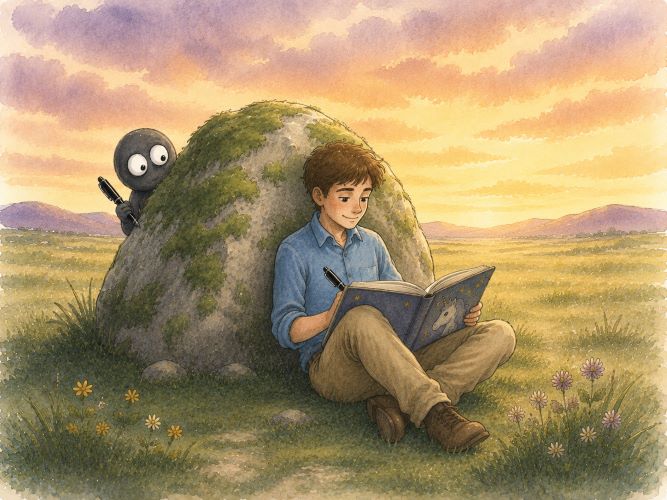
In Part 2, I’ll talk about what you can do to get your unique writing voice out of hiding and onto the page.
In the meantime, what’s your biggest hurdle to getting you on the page? If you’ve found your unique writing voice, how did you do it? Comment below. I’d love to hear your thoughts.
FAQ
Voice is innate. It’s coded into you at birth and develops unconsciously with every experience you have throughout your lifetime. You may not be able to access it, but it’s there.
Style is the conscious, trainable side of writing. It comprises skills like grammar, punctuation, sentence rhythm, word choice, etc. and how you apply them. Voice is the instinctive sensibility made up of your genetics, education, experiences, and way of seeing and interacting with the world.
You can. You just haven’t figured out how yet. It might be afraid to show itself because it’s blocked by anxiety or fear of judgment, or smothered under too many “rules,” or you may not yet know what you actually think or feel.
That concern is usually a disconnection from self. In my experience, it’s most common in people who’ve spent so many years deferring to the needs of others they’ve lost track of who they really are and how they really feel and what they really think and want. Once those things are excavated, your writing voice will follow.
Get in touch
If you’d like to chat about how I might help you find your unique writing voice, send me an email at hello@wordservings.com or click the button.
*All images on this page are AI-assisted